Last week it was a rumor. Now it's $115 billion.
I wrote about this one last week, when it was still just talks. I said the scarce thing in AI right now is the light between the chips, not the chip itself. On Monday, that rumor turned into a signed deal.
Marvell is buying Lumentum for $115 billion. All stock, no cash. That number is bigger than Microsoft buying Activision for $68.7 billion, and bigger than Dell buying EMC for $67 billion. TechCrunch called it one of the largest deals in tech history.
The terms are simple enough to say out loud. Each Lumentum share turns into 4.5 Marvell shares, worth about $1,132 per share at announcement. That's roughly a 24% premium over where Lumentum closed on October 28, the last trading day before the talks leaked. When the deal closes, Marvell shareholders will own about 67% of the combined company and Lumentum shareholders about 33%. Both boards approved it unanimously.
It won't close tomorrow. The companies expect the first half of 2028, and it still needs shareholder votes and regulatory approval. That's a long runway, and a fixed share ratio means the final dollar value will move with Marvell's stock price until then. The $115 billion is the enterprise value at announcement, including debt. The equity value is about $80 billion. The headline alone makes it sound more settled than it is.
I'm a WGU software engineering student who works in IT support and writes code at night. I have never bought a company. I have never worked on optical hardware. So I am not going to pretend I can judge whether $115 billion is the right price. What I can see is the shape of the bet, and the shape is the same one I wrote about last week, only now it's signed.
Marvell makes custom chips and networking gear. Lumentum makes the lasers and optical parts that carry data between servers inside a data center. Put them together and you get one company that sells the whole path: the chip, and the light that carries what the chip computed to the next rack. Marvell says it will become a leader in AI connectivity. Lumentum's CEO put the market opportunity at $550 billion. The companies also say they see a path to more than $1 billion a year in run rate cost savings. That last one is their claim, not a result. I'll believe it when it shows up in an earnings report.
There is one detail that stopped me. Nvidia invested $2 billion in each company back in March. Two billion into Lumentum to support its laser work and factory expansion. Two billion into Marvell to build up its optical networking and chips. So the biggest customer in this whole story already had money on both sides of the table before the deal existed. That scares me a little, honestly. Not in a conspiracy way. Just in the way where one company keeps showing up in every important sentence.
The other story from the same day
Monday had a second story, and it pairs with the first one.
The New York Times sued Brave, the privacy focused browser company, in federal court in Manhattan. The same day, the publishers of the Daily News, the Chicago Tribune, and the Orlando Sentinel filed a similar suit. The Times says Brave scraped its copyrighted content into an index of more than 30 billion web pages, using a crawler publishers say they can't detect or block, and then sold AI companies access to that index. The suit names Anthropic, Perplexity, Mistral, xAI, and Cohere as customers. Those companies are not defendants here. Brave is.
The suits also target a Brave browser feature the publishers call a paywall blocker, and Brave's practice of blocking publishers' ads while selling its own. The Times is asking for an injunction and damages, and it called Brave a supplier, dealer, and distributor of stolen content for AI companies. Brave did not immediately respond. Perplexity, for its part, dismissed the suit in a sharp statement. All of this is allegation so far. No court has ruled.
I keep thinking about these two stories side by side. One company just paid $115 billion to own the light that moves data around a data center. Four newspapers went to court over who gets paid when their words move around the internet to train AI models. Same day, same question from opposite ends: moving data is now the valuable part, and nobody agrees who owns what once it starts moving.
I don't know how the Brave case ends, and I don't know if the Marvell deal clears regulators by 2028. I do know which kind of work keeps looking durable from where I sit. It's the physical, specific stuff. Fiber, optics, interconnects, power, cooling. The things you can point at in a room. Last week I wrote that the bottleneck was the light between chips. This week somebody put $115 billion on that sentence. I still don't know if they overpaid. But I feel better about learning the boring layer underneath the models, because that's the layer everybody is suddenly willing to fight over.
Sources: TechCrunch, November 2, 2026, Stocktwits, November 2, 2026, TechCrunch on the Brave lawsuits, November 2, 2026
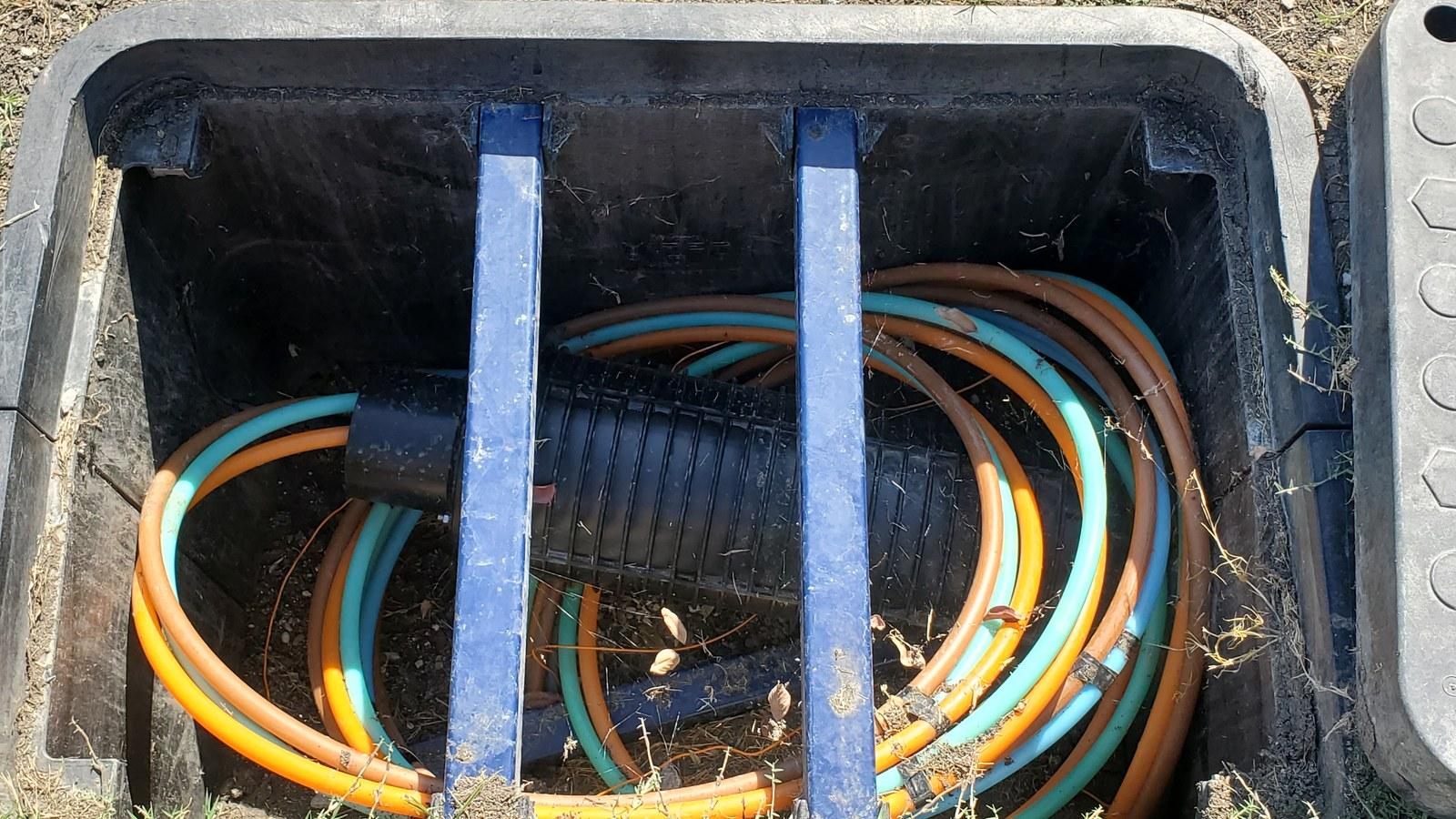
Cover photo: "A NOVOS fiber inside a box to the home" (October 26, 2024), by Ranch9613, via Wikimedia Commons, CC0 1.0, cropped to 16:9.