The chipmaker is now the bank, and the computer is now in orbit
I read this one this morning and I just sat there for a second. Nvidia, the chip company, might co-sign a loan.
Not sell chips. Not invest. Co-sign. Like a parent signing for a kid's first apartment, except the apartment is a data center and the rent is in the billions.
Reuters reported on October 30 that Nvidia is in talks to offer AI cloud provider Nscale billions of dollars in credit guarantees, citing The Information. TechCrunch picked it up the same day, noting Bloomberg later corroborated the report. Nothing is signed yet, and the companies did not respond to Reuters, so treat this as reported talks, not a done deal.
The money would fund power and construction for Nscale's West Virginia campus, which Anthropic plans to use. Anthropic has already signed a contract worth about $44.6 billion for the first building alone, according to Nscale's IPO filing cited by TechCrunch. That building is 460 megawatts and is expected to run Nvidia's next-generation Vera Rubin chips. The companies are also talking about a second deal worth roughly another $45 billion.
I had to look up the structure, because I am not a finance person. I am a WGU software engineering student who works in IT support and still types his own commits at night. The arrangement is called a residual value guarantee. If Nscale defaulted, Nvidia would step in, temporarily take over the facility, and help find a buyer and a new tenant. Nvidia has backed leases and chip purchases before. This would be different, because it covers construction itself.
That detail is the whole story to me. A guarantee like that only makes sense if lenders are nervous. And they have reasons to be. Nscale is trying to go public at a valuation of up to $35 billion, and TechCrunch reports it had only about 25,000 advanced AI chips running in August, against a plan for nearly 500,000. The Information puts Nvidia's total investments and credit support to neoclouds and large customers at roughly $170 billion, including $1 billion in convertible financing committed to Nscale in September.
I keep thinking about the Nscale story from earlier this month, too. Microsoft pulled out of a planned Nscale site in England after grid power for it got pushed into the 2030s. Same company, different problem. In England the problem was a power outlet that would not exist for years. In West Virginia the problem is money to build the thing at all.
That scares me a little, in a useful way. Not because I think the whole boom collapses tomorrow. I do not know enough to say that. It scares me because the chain is getting circular. Nvidia sells the chips, invests in the buyer, and now might guarantee the loan for the building that houses the chips. That is not a normal supplier relationship anymore.
The part that got me
On the exact same week, Google answered a prompt from space.
Google said on October 30 that its Project Suncatcher prototype satellite reached its "Hello World" milestone: the first AI response from a data-center-class TPU in orbit. The satellite launched on October 1. During a ground-station pass, engineers sent a prompt to its onboard Gemma 4 open model and asked for a haiku about being in space. As it passed over Svalbard, Norway, it sent this back:
Blue marble below Data streams in silent grace Starlight feeds my core.
Google says it then tried limericks and telemetry prompts. Next come thermal and radiation tests, with twin satellites planned for 2027 if the chips hold up.
I love that story and I also do not want to oversell it. This is one prototype answering test prompts, not a data center taking customer jobs. TechCrunch reports the satellite generates up to 1 kilowatt of power and can run only one of its four TPUs at a time, for about 20 minutes. Google's own post does not give those figures, so I am flagging them as TechCrunch's reporting, not Google's. A haiku does not prove orbital computing is cheap or scalable. It proves the chip turned on, ran a model, and phoned home.
Put the two stories next to each other and the week feels weird in a specific way. On the ground, the buildout is so expensive that the chipmaker has to become the bank. In the sky, it is so constrained by power and heat that a satellite can only run one chip for 20 minutes at a time. Same bottleneck, opposite extremes.
For someone like me, applying to IT roles and learning this stuff from the bottom up, that actually narrows the question. The durable work is not knowing which model is hottest this week. It is the stuff that shows up in both stories: the building, the power, the networking, the access controls, the incident response when something floods or fails. TechCrunch notes runoff from the West Virginia construction site has flooded nearby homes more than once. That is not a model problem. That is a site problem.
I do not know if Nvidia signs the guarantee. I do not know if Suncatcher's chips survive radiation testing. I know I would rather learn the boring, checkable skills than bet my career on the next announcement. The announcements will keep coming. The buildings, and the bills for them, are what stick around.
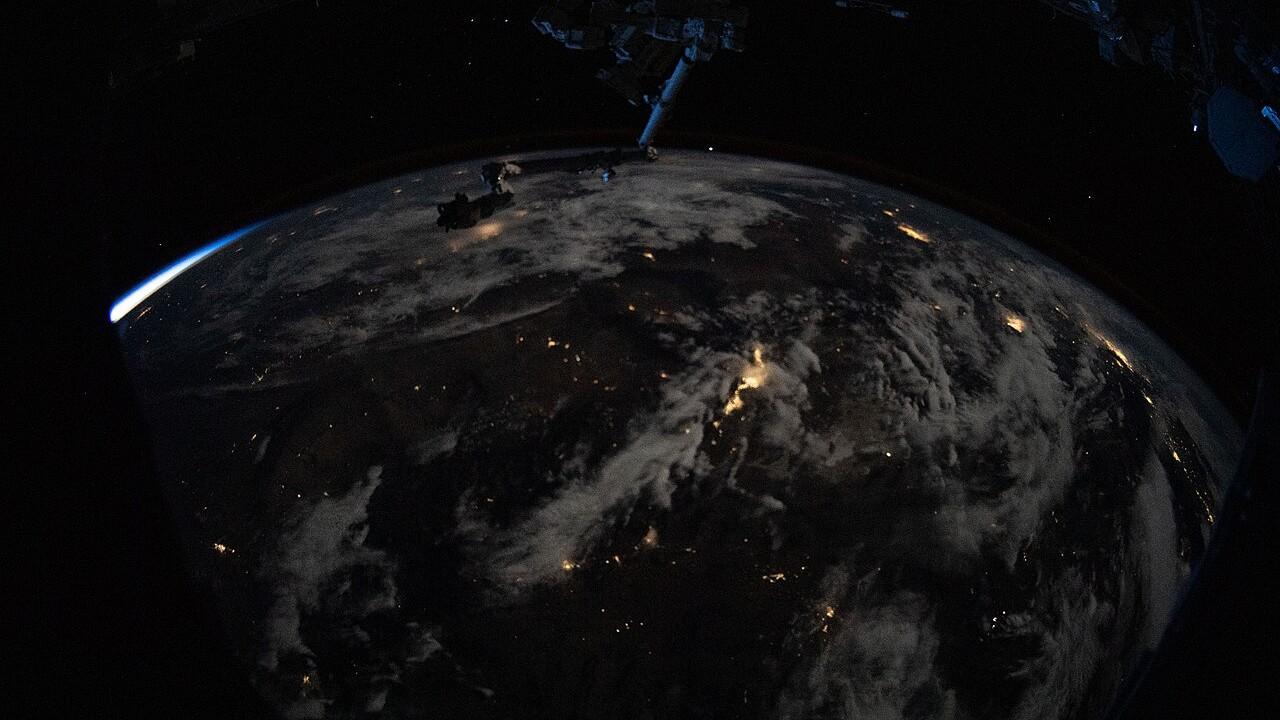
Cover photo: Earth seen from the International Space Station, a public-domain NASA photo via Wikimedia Commons.