Outlook Went Down. Claude's Going Public.
Friday morning I had three interviews. Ten, twelve, one. All for the same Amazon data center tech role. I'd been prepping for weeks, doing mock interviews at night after work.
While I was getting ready, Microsoft was still digging out of a global outage that started the day before. Outlook. Teams calendars. Copilot. All of it down or half-dead for most of Thursday and into Friday morning.
My interviews weren't affected, as far as I know. But the timing stuck with me. The same week I was interviewing for a job keeping data centers running, the email half the planet uses for work just stopped.
Thursday morning, November 12, people started losing access to their Exchange Online mailboxes. Microsoft opened incident EX1550543 at about 10:17 in the morning Central, then a second one, MO1550821, for everything else that leans on your mailbox. Outlook on the web, the desktop app, your phone. Then Teams calendars and scheduling. Copilot. SharePoint. Planner. Even some Microsoft Defender features.
Downdetector logged more than 120,000 Outlook problem reports at the peak, from 74 countries. Courts, airlines, government offices in Singapore and Japan. It wasn't just office workers. It was everybody.
Microsoft says it was not a cyberattack. A Microsoft executive, Charles Lamanna, said so directly. The cause, in Microsoft's words, was an issue during an earlier network capacity upgrade that surfaced after a recent network change. A change exposed a fault from an earlier change. That's it. That's the whole story. One network change, and email died for a day.
It was fixed by early Saturday morning Central. Microsoft's final update said the services had fully recovered and the backlog of delayed email had been processed. They also stretched the email delivery timeout to 48 hours so delayed messages wouldn't bounce. The full post-incident report hasn't been published yet. (Timeline and details, second account)
I read that and I thought about my ticket queue. I've closed 2,579 tickets. A huge chunk of them were somebody's Outlook. Password expired. Mailbox full. Shared calendar won't load. The glamorous stuff never shows up in the queue. It's always the boring layer. And when the boring layer breaks, nobody asks about the AI roadmap. They ask when their inbox is coming back.
That's the first story. The second one is the other side of the same coin.
Anthropic, the company behind Claude, is about to become a public company. It filed its S-1 on October 26. On November 10 it set the terms: 825 million shares at $70 to $78 each. That would raise up to about $64 billion and value the company at up to roughly $1.4 trillion on a fully diluted basis. Nasdaq says it expects trading to start Thursday, November 19, under the ticker ANT. The price is expected to be set November 18, according to CNBC's reporting. None of that is final yet. The filing itself doesn't name a date, and the registration isn't effective. But the roadshow is real and the numbers are on file. (Terms from the filing, price range and dates)
The numbers stopped me. Revenue for the first nine months of 2026 was $33.2 billion, up from $2.5 billion a year earlier. Run-rate revenue hit about $81 billion at the end of October. And the net loss for those same nine months was $104 billion, mostly financing-related accounting charges. The operating loss was $1.3 billion. Meanwhile the company has $900.9 billion in compute and infrastructure commitments sitting on its books, against about $132 billion in cash and short-term investments.
I don't own stock. I don't know how IPO pricing works. I'm not going to pretend I do. But I know what a commitment looks like. On a ticket, a commitment is a promise someone has to keep later, with real money and real dates attached. $900.9 billion in commitments against $33.2 billion in nine-month revenue is a lot of promises to keep later.
And about a fifth of the offering is reportedly aimed at regular retail investors, which is way above normal. So the same week your inbox broke, your neighbor might get a chance to buy a piece of the company that makes the chatbot.
Put the two stories together and you get the week in one sentence. AI stopped being a demo. It became infrastructure. Infrastructure breaks, like email did on Thursday. And infrastructure gets sold to the public, like Claude's parent company will be on Thursday.
I've spent the last month writing about data centers and power and permission slips. This week the lesson landed closer to home. The work that matters isn't the model. It's the layer underneath it. The network change that nobody reviewed carefully enough. The inbox that has to open when you click it. The review queue, the ticket queue, the change window at 2 a.m. that somebody has to own.
That's the job I interviewed for. And honestly, after this week, I want it more, not less. Somebody has to keep the boring layer running. Turns out the whole AI boom is standing on it.
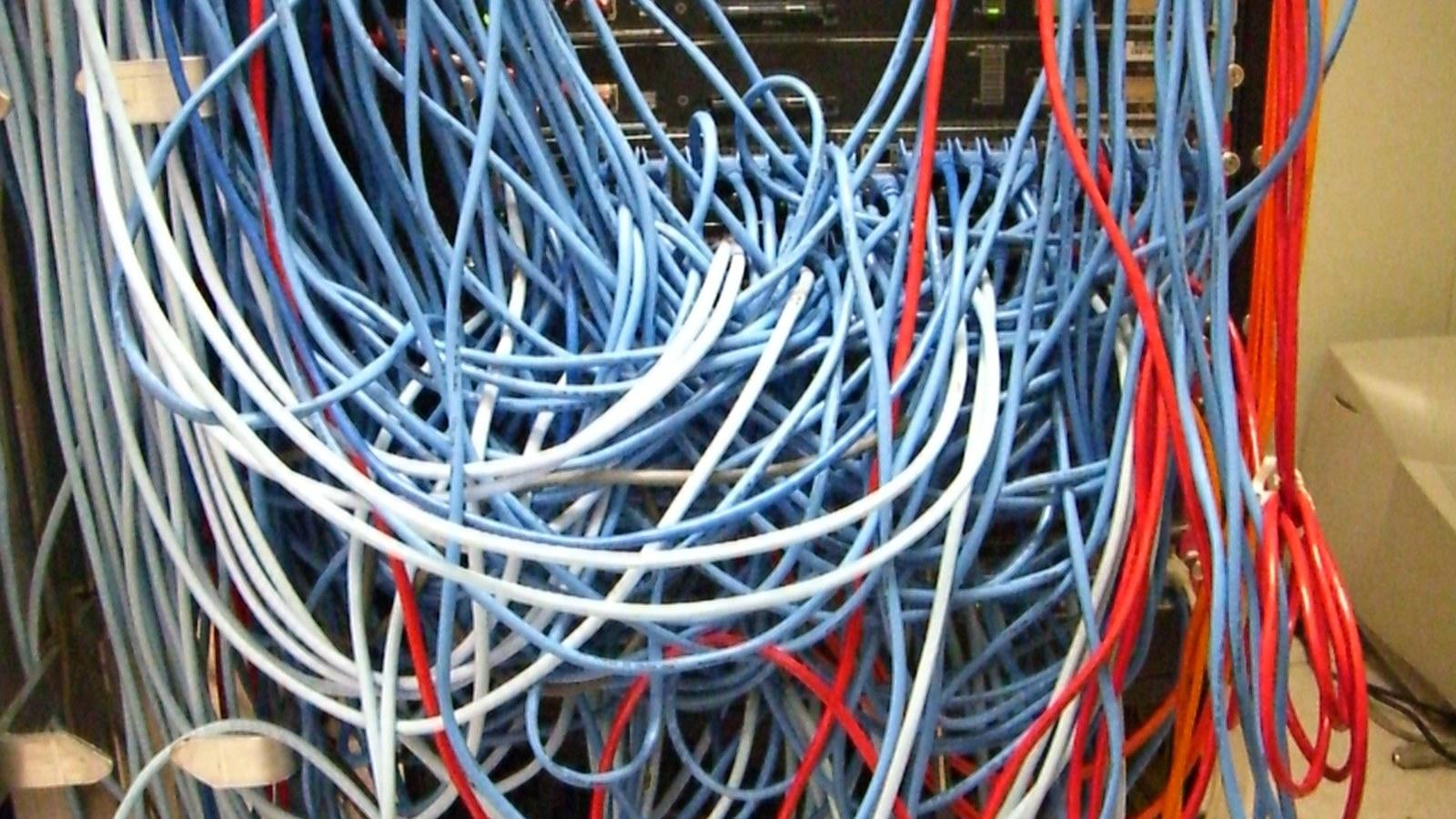
Cover photo: Kim Scarborough, CC BY-SA 2.0, via Wikimedia Commons. A server rack with a spaghetti-like mass of network cables, Chicago, 2006.