The voters said no. The chips are still selling.
I wrote about this one two days ago, when it was still a preview. Forty-one data center measures were on ballots across ten states, and I said a name is not a compact. A compact is not yet a result.
Well. Now we have results. And the results are loud.
By Wednesday morning, 33 local ballot measures restricting data centers had passed or were leading in counts still under way, according to Stateline's tracker. Only one measure, in North Dakota, went the builders' way. The Washington Post counted it a different way, at least 29 jurisdictions passing bans or restrictions, with at least 14 of those in Ohio alone. Those two counts measure different things, jurisdictions versus measures, and both are partial. Most of Tuesday's counts are still unofficial. But the direction is not in dispute. Nobody is arguing about which way it went.
Ohio was the center of it. Voters there faced 21 measures, more than half the national total. In Joliet Township, Illinois, nearly 80 percent voted to restrict data centers. In Hubbard, Ohio, more than three quarters did the same. In Trenton, Ohio, it was 80 to 20 for a ban on large data centers. In Sunbury, Ohio, the unofficial count for banning data centers of 25 megawatts or more was unanimous.
And it went past the local ballots. In Texas, Gina Hinojosa beat Governor Greg Abbott, 52.8 percent to 45.7 percent with about 93.5 percent of the expected vote counted, running on a moratorium on new data center construction, stricter rules on their water and power use, and an end to tax breaks for the industry. Abbott had announced a moratorium of his own. Hinojosa called it an election year pause. Voters agreed with her version.
In Georgia, Keisha Lance Bottoms won after making a statewide pause part of her pitch on energy bills. Her line, quoted by WTOC, was plain: "Georgia is currently No. 1 in the country for data centers. We need to pause." In Ohio, Amy Acton beat Vivek Ramaswamy, 52 percent to 44.7 percent, and both candidates had promised tougher conditions on new data centers. So even the losing side in Ohio was running against the buildout.
Reuters called it a referendum on AI more than a referendum on a president, quoting an investment strategist at Amundi. Elon Musk, who spent heavily backing conservative candidates, posted after the election that data centers in space were looking pretty appealing. That is a joke, but it is also a tell. When the richest guy in the room starts joking about leaving the planet, the room has changed.
I should be honest about what a governor can and can't do. A governor can't stop a project alone. New state rules need lawmakers and regulators. A moratorium promise is a direction, not a finished law. And a vote in Ashville, Ohio to overturn an agreement with a developer won't stop construction that is already under way there.
Now the other half of Tuesday, because it happened on the same day and it matters just as much.
AMD reported after the market closed. Total revenue hit $13.38 billion, up 45 percent from a year earlier, beating estimates of $13.09 billion. Data center revenue jumped 97 percent to a record $8.55 billion, above the $8.20 billion analysts expected. That segment is now about 64 percent of the whole company. For the fourth quarter, AMD guided to about $17 billion in revenue, plus or minus 3 percent, above the $16.23 billion average estimate. CEO Lisa Su told analysts she expects overall revenue to grow more than 80 percent in 2027, with 80 percent of next year's sales coming from data center chips. Shares rose 8 percent in extended trading.
Put those two stories next to each other and you get the whole picture. The demand did not fall. The permission did.
I'm a WGU software engineering student who works in IT support and writes code at night. I have never negotiated a power contract and I have never run a data center. But I spend my days on tickets, and tickets teach you something useful: the thing that breaks a project is rarely the technology. It's the part nobody wrote down clearly. Who pays for the power. Who pays for the water. What happens to the neighbors' bills. Whether anyone asked the town first.
AMD's numbers prove the other side too. There is now a real second supplier at rack scale, not just a chip vendor. Its Helios rack, pairing its MI455X accelerator with new Venice server chips, is in production, with a larger ramp set for the fourth quarter and initial systems being tested at Meta. That matters to anyone learning this field, because it means the skills travel. Racking, networking, cooling, and running a building full of someone else's accelerators is work no matter whose logo is on the box.
So no, the AI boom did not end on Tuesday. The chips are still selling, faster than ever. But the buildout just got a new boss, and the boss is the voter in line at the polling place. The companies that figure out how to be good neighbors, in writing, with numbers, before they ask for power, will be the ones still building in three years.
I wrote on Monday that a name is not a compact. Turns out a vote is not a compact either. It is something stronger. It is a condition.
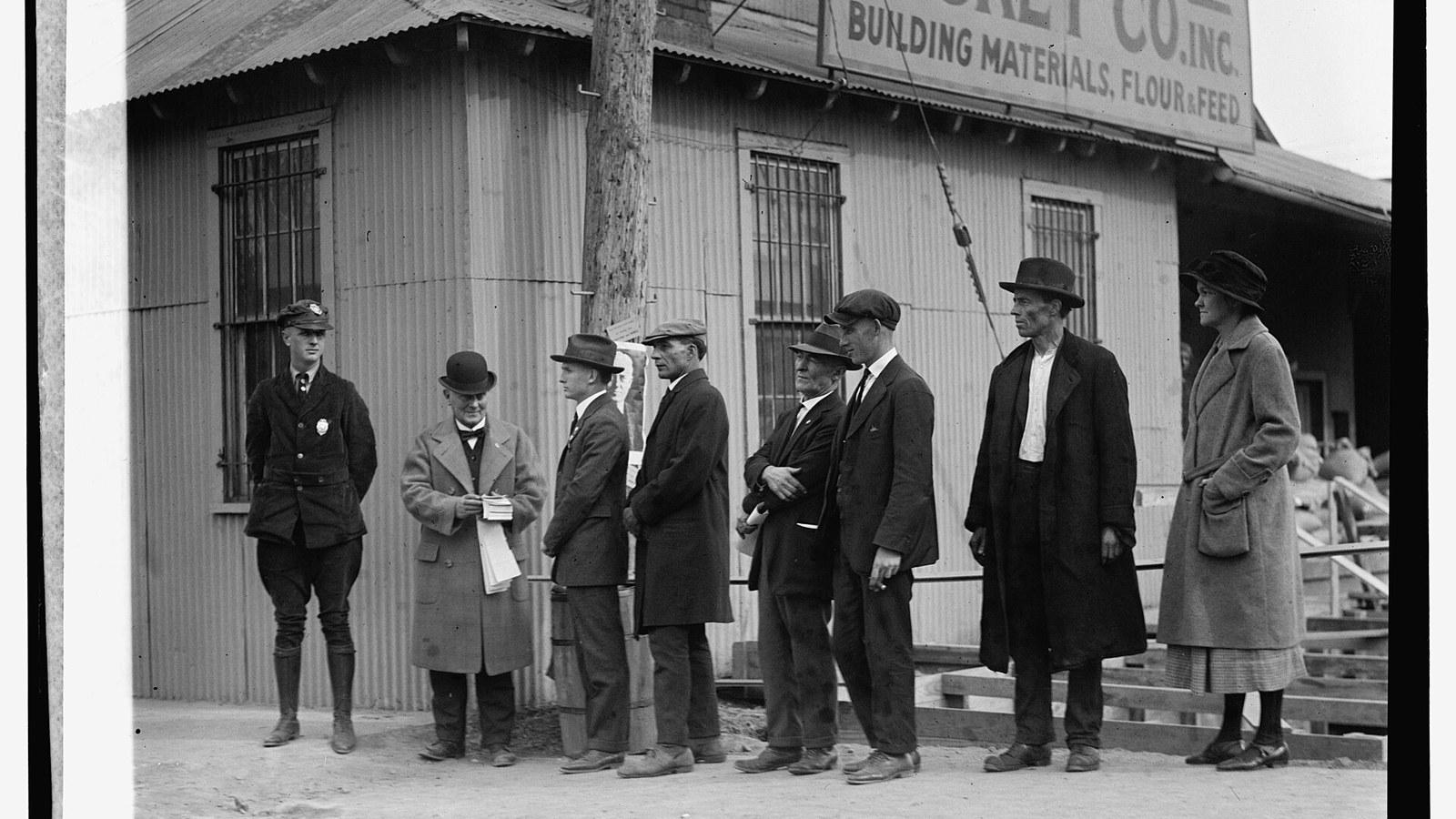
Sources: Reuters on the midterm results, Stateline's count via this roundup, the Washington Post's count via this roundup, Reuters on AMD's quarter. Cover photo: a historic line of voters outside a polling place, National Photo Company Collection, Library of Congress, public domain via Wikimedia Commons.