When the town says no
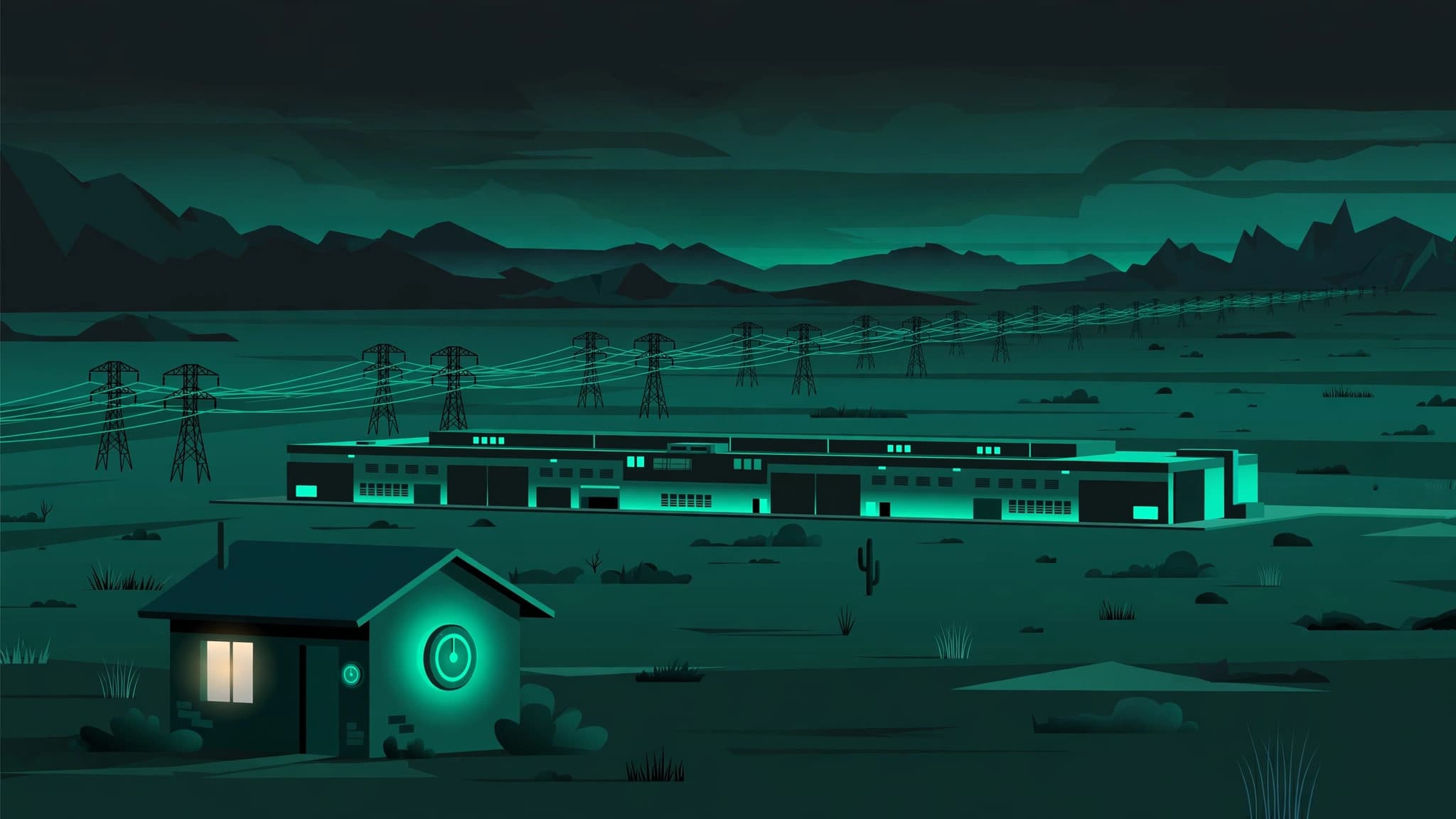
I was up early on a Sunday, coffee in hand, scrolling before the day had really started. Two stories, back to back, and they clicked together in a way neither one did alone.
Five days ago I wrote about Microsoft walking away from a data center site in England because the grid told them power wouldn't arrive until the 2030s. That was the first time I'd seen the boom just give up and leave.
This week I found out what happens after the no. It doesn't stop. It finds another door.
Door number one: land you own
Land records show at least 35 data-center-related applications pending or active on US federal land, covering more than 24,000 acres across six western states: Arizona, Idaho, Nevada, Oregon, Utah, and Wyoming. That's from an analysis of Bureau of Land Management records by the conservation group Center for Western Priorities, reported by Reuters on October 20 and picked up again by TechRadar this week.
Seventeen of those are full data center campuses. Thirteen more are the supporting stuff: transmission lines, pipelines, telecom facilities, access roads.
The reason this matters is the permitting. On federal land, developers can skip a lot of the reviews and local votes that a normal site has to go through. The rules let projects bypass standard environmental reviews and local zoning oversight.
One proposal in eastern Utah covers more than 9,000 acres and would be powered by small modular nuclear reactors, according to Data Center Dynamics. Nine thousand acres. For one project.
And there's already a preview of how this plays out. In Boulder City, Nevada, residents fought off a data center proposal over the summer. Then the developers came back seeking adjacent federal land instead, and the Bureau of Land Management signed off. One resident told the Associated Press: "Not only did we not get to decide anything or have a say, we were just really kept in the dark." Construction there is now stalled after a judge ruled the government couldn't reuse an old environmental review from when the site was supposed to be a solar farm.
So the town said no. The project moved next door, onto land where the town doesn't get a vote. And even that shortcut hit a judge.
Door number two: your thermostat
On October 22, Google and Voltus expanded a deal to build a 1-gigawatt virtual power plant in the PJM grid region, which serves 67 million customers across 13 states and DC. They started at 100 megawatts in June. This expansion adds 1,070 megawatts. Quick honesty note: 100 plus 1,070 is 1,170, not 1,000. Both companies still call it a 1-gigawatt plant. I don't know why the math doesn't match, and I'm not going to pretend I do.
The idea is simple. Voltus signs up homes and businesses with batteries, smart thermostats, on-site generation, or industrial processes they can dial back. When the grid is under strain, Voltus signals those sites to use less. Participants get bill savings or direct payments. Google pays for the capacity instead of building a power plant. The announcement is here.
Ellen Zuckerman, Google's head of energy market development for North and South America, said expanding tenfold shows Google bringing its own capacity to the grids that serve it. Voltus says the contract runs through 2040, with capacity ramping up over three to four years.
I like this one more than I expected to. Not because it's pure or clean. It's not. It's a company buying its way out of a queue problem with other people's thermostats. But at least the money flows to the people near the grid, not just to the company building the hall. And unlike a nuclear plant, it doesn't take a decade.
Now put the two doors side by side, because that's the part that got me.
Five days ago: a company walks away when the grid says no. This week: the industry routes around the no in both directions. One way, it goes to land where nobody local gets a say. The other way, it pays the locals to share their power.
One of those futures has a public in it. The other one just has acreage.
I'm a software engineering student. I don't know permitting law. I know tickets. I've closed 2,579 of them at Amazon, and most of them taught the same lesson over and over: the boring process is the product. Skip the process and you pay for it later, usually at 2 a.m., usually in public. Boulder City already proved that part. A judge is the 2 a.m. page.
The jobs angle, since that's the part I actually care about: the scarce work in this industry keeps moving further from the code editor. It's interconnection studies, permitting, grid planning, demand response programs. The stuff that decides whether a building gets power and whether the neighbors agreed to it. That's learnable work. It's not genius work. It's paperwork and power lines and showing up to meetings.
I ship a little code every night. That's still the habit I'm proudest of. But this week reminded me that my code runs on buildings that need land and power first. And right now, the fight over both is happening in places most developers never look: a BLM land record in Wyoming, and a thermostat in Pennsylvania.